Speed Kills.
Why Speed Is the Ultimate Difference-Maker in Sport
Everyone says speed matters. Almost nobody trains it. Here’s why speed is the primary motor quality in sport — and why ignoring it during youth development is a costly mistake.
The Play I Could Never Stop
Imagine this play.
It’s a midsummer afternoon. The clouds are gathering for their evening rain. It’s humid, and you can feel the sweat running down your face. You’re wearing a football helmet, standing on a football field, playing linebacker.
Before the ball is snapped, you already know the play.
You know three things: who is getting the ball — the wide receiver. Where the play is going — to your side of the field. When the play is starting — on “go.”
The offense runs a pitch to an extremely fast receiver coming across the backfield. And it’s your job — your job alone — to tackle him.
The play starts. You react immediately. You take a great angle. You run as hard as you can.
And yet, no matter how much you try, no matter how fast you run, you cannot catch him.
Not because you’re slow. Not because you’re out of position. But because he is faster than you.
After the play, everyone lines up again. And like a horrible Groundhog Day, they run the exact same play. Same result. Then again. Same result.
A nightmare, right?
I didn’t have to imagine this. I was that linebacker.
And I could never catch that receiver.
As my dad used to say: speed kills.
The Need for Speed in Team Sports
Let’s talk about speed training — because for all the lip service it gets, it’s still one of the most misunderstood and undertrained qualities in sport.
There are three fundamental questions every coach should be able to answer: What is speed? Why is speed important? How do we actually develop it?
Ask almost any coach involved in a running or skating sport what the most important physical quality is, and they’ll all say the same thing: “Speed.”
But if you watch their behavior, something strange happens.
They almost never train it.
Why Speed Is Rarely Trained (Despite Everyone Saying It Matters)
Athletes will often say, “We’re always running fast. Practice is full speed. Games are full speed.”
The data says otherwise.
Athlete GPS tracking has been around for decades now, and at the national and professional level its use is nearly universal. And what does that data tell us?
It tells us that athletes almost never reach true maximum velocity in practice. Even in games, most movement is acceleration, deceleration, and submaximal running, with only brief and rare exposures to true top speed.
And yet, those brief moments — the ones where athletes do hit max velocity — are often the moments that decide games. Breakaway plays. Chasedown tackles. Separation at the top of a route.
Speed still wins. And yet, it still isn’t trained properly.
Why Coaches Avoid Speed Training
There are two main reasons.
1. Fear
Almost every coach has seen it happen at least once: an athlete runs a max sprint — often a 40-yard dash — and pulls a hamstring.
Even if this happens once in an entire career, it leaves a mark. Especially if that athlete was a key player. From that moment on, full-speed sprinting outside of games feels dangerous — rightly or wrongly.
2. The Practical Misconception
Coaches, players, and parents assume athletes are “always sprinting” during practice and competition.
But again, the data doesn’t support this. True maximum velocity sprinting is rare. And when it’s rare, the tissues, nervous system, and mechanics required to express speed never fully develop.
So speed training gets pushed aside — or more often, doesn’t get a seat on the bus at all.
“That’s a huge mistake. It was the mistake I made when I played football.”
— Greg Almon, Jungle Athletics CalgaryWhat Is Speed? Quickness vs. Maximum Velocity
Quickness is a type of speed. It refers to the ability to cover very short distances rapidly — first steps, reaction speed, short accelerations. It’s useful, and it’s trained often.
Speed, in the truest sense, refers to the ability to reach and maintain maximum velocity over a larger distance.
Acceleration matters. Quickness matters. But maximum speed is the ceiling.
You cannot express speed in a game if you don’t have it in the first place.
Moving Fast vs. Playing Fast
I once watched a track athlete transition into football. On paper, he was elite — a legitimate 4.3-second 40-yard dash. Blazing fast.
But on the field? Just okay.
What happened? He could move fast, but he couldn’t play fast.
Playing fast depends on four interrelated abilities:
Can the athlete execute the sport’s skills efficiently?
Do they know where to go and when?
Can they process information and act under pressure?
Do they possess enough raw speed to matter?
Game speed is the ability to apply physical speed inside technical and tactical constraints.
But here’s the key point: you cannot leverage speed you don’t have.
This is the core idea behind our Adaptive Game Speed framework — having speed is the foundation, but expressing it under fatigue, chaos, and real-game pressure is what separates dominant athletes from everyone else.
How Speed Is Actually Developed
Speed development is not accidental. And it’s not random. It requires correct periodization, placed logically within the training week, while keeping the athlete as fresh as possible.
Real speed development includes short, high-quality sprints, proper warm-ups, low fatigue, undulating intensity and volume, and readiness-based decision making.
At Jungle Athletics, we use nervous system readiness metrics to decide when an athlete should sprint.
One of the most important metrics we track is ground contact time during a depth jump from a 12-inch box. For teenage athletes, if ground contact time falls in the 0.11–0.14 second range, they are neurologically ready to sprint at high speeds. The nervous system is firing. The body can handle it. This is when we train speed.
If ground contact time is higher than that range, the athlete is not neurologically ready. Running fast when the nervous system isn’t prepared doesn’t develop speed — it reinforces poor mechanics and increases injury risk. This is when we adapt the session.
This is the same battery-management approach we use across all of our programming. You can’t build speed on a drained system.
The Golden Years of Speed Development
This matters even more for developing athletes. There are well-established sensitive periods of speed development — often referred to as the golden years of athletic development.
But here’s what most coaches and parents miss: speed expression depends on foundations that must be built earlier.
Before an athlete can express maximum speed, their body needs to have already developed a set of underlying qualities — qualities that are built during childhood, often years before speed itself becomes the focus.
Those foundational qualities include:
- Proprioception — knowing where your body is in space without looking
- Rhythm and tempo — the ability to time movements with precision
- Stiffness and reactivity — how quickly and efficiently the body absorbs and redirects force through tendons and joints
- Elasticity — the stretch-shortening cycle that makes explosive movement possible
- Coordination — the ability to organize complex multi-joint movements under changing conditions
These aren’t “speed qualities” in the traditional sense. Most people wouldn’t look at a 9-year-old doing rhythm and balance drills and think, “That’s speed training.” But it is. These are the raw materials that speed is built from. Without them, an athlete trying to express max speed is like a house built without a foundation — it might stand for a while, but it won’t hold up under pressure.
This is why the development windows matter so much. The coordination and motor pattern windows open first — ages 8 to 12. The speed expression window opens after — ages 12 to 14. If an athlete skips the first window and jumps straight to “speed work,” they’re trying to express something their body was never taught to produce.
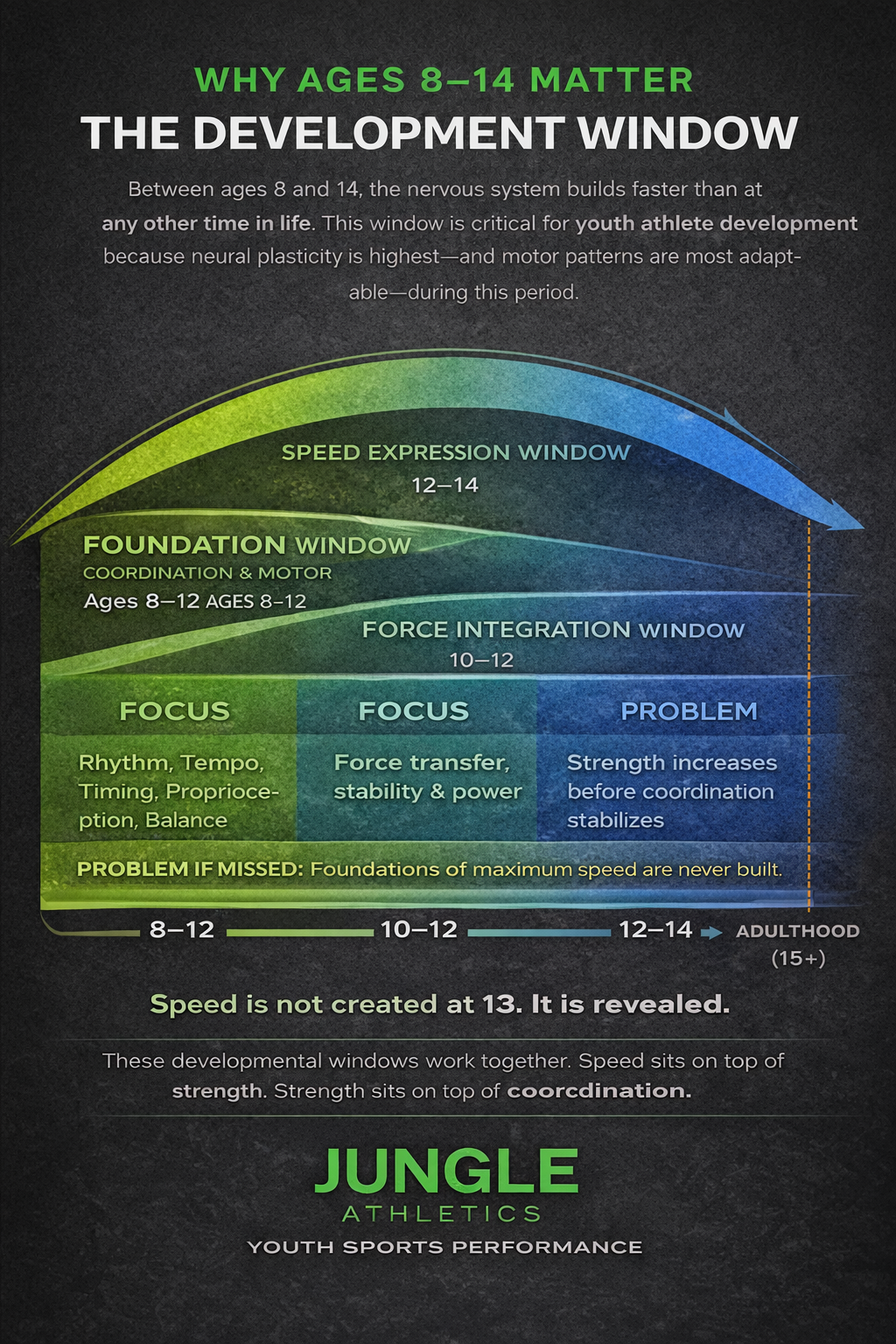
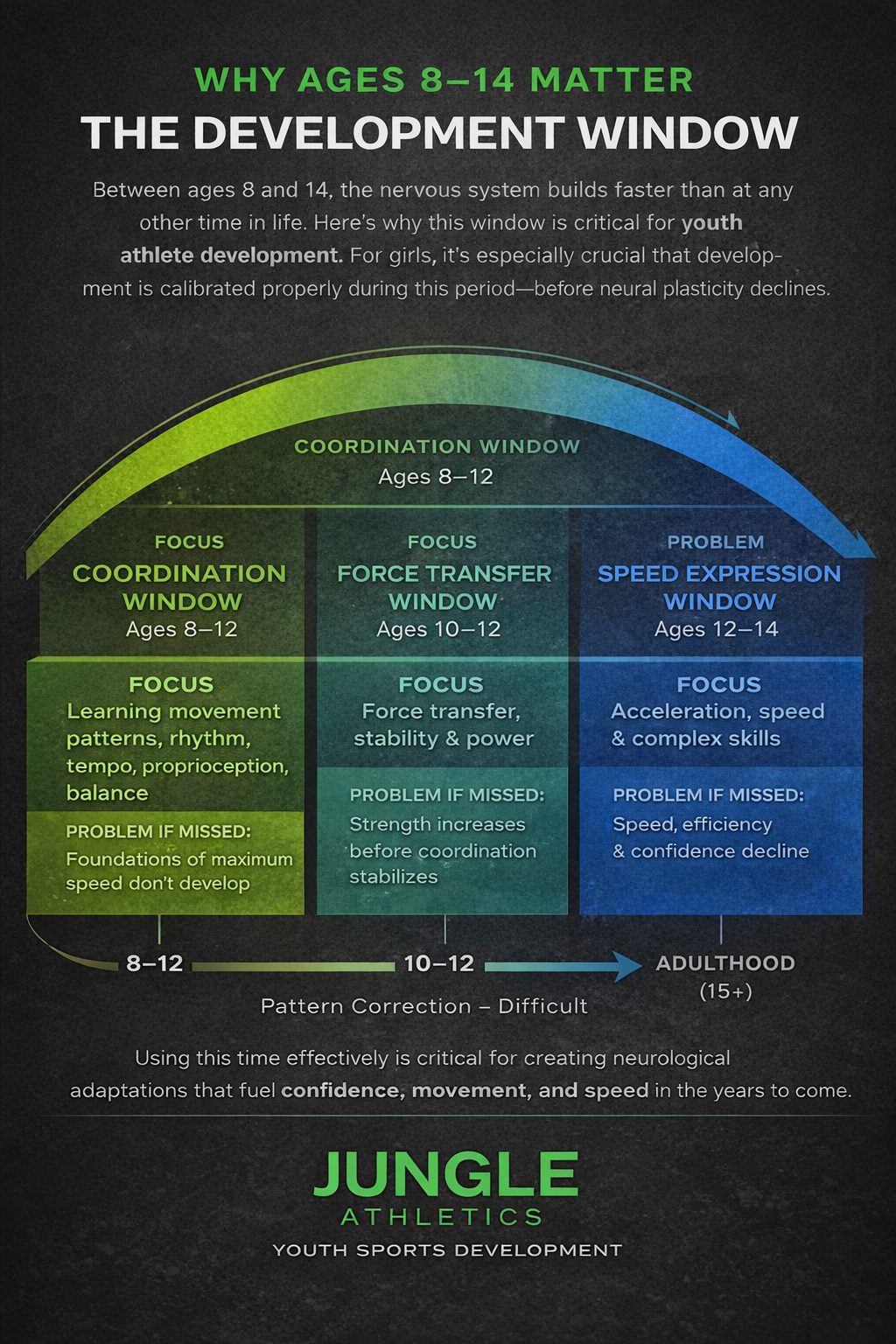
The athletes who look “naturally fast” at 14 and 15 aren’t lucky. They had these foundational qualities developed — whether by accident through diverse sport play, or by intent through proper training — during the years when their nervous system was most adaptable.
This is why ignoring speed training during youth development isn’t just a missed opportunity — it’s a developmental error.
We go deeper on developmental windows and why ages 8–14 are the most critical period in our Youth Athletic Development pillar — including the Adaptive Game Speed framework that connects coordination, force transfer, and speed expression into a complete system.
Speed Is the Primary Motor Quality in Sport
That practice from decades ago taught me something that stuck: speed is the primary motor quality in all running and skating sports.
If you have it, opportunities open up. If you don’t, the margin for error disappears.
Speed isn’t just another physical quality. It’s the foundation that everything else in sport sits on. Acceleration, agility, deceleration, and even endurance all live downstream from speed. If the ceiling is low, everything underneath it is limited. If the ceiling is high, suddenly the game opens up.
Final Thought
Speed doesn’t just “show up” in games. And it doesn’t develop just because athletes play their sport.
It must be trained. It must be respected. And it must be placed in the right spot, at the right time, with the right intent.
I learned that the hard way — chasing a receiver I could never catch.
And it’s a lesson I make sure the athletes I coach don’t have to learn the same way.
“Speed still kills. But only if it’s trained with intent, at the right time, in a way that respects both performance and development.”
— Greg Almon, Jungle Athletics CalgaryDevelopment System Explained
If this article is your first introduction to Jungle Athletics, speed development is one piece of a larger training system. Before booking, most parents find it useful to understand how speed, coordination, the Battery Model, and the athlete analysis all connect.
How Fast Could Your
Athlete Actually Be?
Book your athlete’s Free Game Speed Analysis. 60 minutes. Our coaches will assess movement, speed mechanics, and nervous system readiness — then tell you exactly where your athlete’s speed ceiling is and how to raise it.
Book Your Free Athlete Analysis134 71 Ave SE · Calgary, AB T2H 0L9
★★★★★ 228+ Five-Star Google Reviews
Leave a Reply